What's the difference between contract and no-contract cell phones?
When shopping for a new cell phone,
The first decision you'll need to make is determining the best plan type for you.
Advantages of a Contract Service Plan
Lower upfront purchase price.
Postpaid devices are often less expensive initially —in most cases hundreds of dollars below the true cost of the device —because the carrier subsidizes your purchase of the device.
The subsidy model enables the carrier to offer you the newest smartphone for $200 or less, rather than the full price of $600 or more if you were to purchase the phone on its own.
Postpaid devices are often less expensive initially —in most cases hundreds of dollars below the true cost of the device —because the carrier subsidizes your purchase of the device.
The subsidy model enables the carrier to offer you the newest smartphone for $200 or less, rather than the full price of $600 or more if you were to purchase the phone on its own.
Easy path to upgrading your phone.
To retain you as a customer, a postpaid carrier will offer to subsidize the purchase price of a new phone at the end of your contract.
To retain you as a customer, a postpaid carrier will offer to subsidize the purchase price of a new phone at the end of your contract.
Access to a wider array of services.
With many postpaid carriers, you'll be able to select from a variety of add-on services, ranging from GPS-based turn-by-turn directions and family locator programs to unlimited music downloads and streaming TV channels.
With many postpaid carriers, you'll be able to select from a variety of add-on services, ranging from GPS-based turn-by-turn directions and family locator programs to unlimited music downloads and streaming TV channels.
Disadvantages of a Contract Service Plan
Hefty cancellation fees.
If you want to switch to another carrier before the end of your contract's term, you'll most likely have to pay several hundred dollars to break the contract.
(This is one way in which the postpaid carrier can make sure it recoups the subsidized price of the phone you purchased and discourage you from switching to another carrier.)
If you want to switch to another carrier before the end of your contract's term, you'll most likely have to pay several hundred dollars to break the contract.
(This is one way in which the postpaid carrier can make sure it recoups the subsidized price of the phone you purchased and discourage you from switching to another carrier.)
Requires a credit check.
Because you're signing up for a two-year contract that ties you to a subsidized phone purchase, postpaid carriers require a check of your credit history —and those with less-than-optimal credit may get rejected.
Because you're signing up for a two-year contract that ties you to a subsidized phone purchase, postpaid carriers require a check of your credit history —and those with less-than-optimal credit may get rejected.
Activation fee.
A postpaid carrier typically charges between $30 - $40 as an activation fee when you first sign your contract.
A postpaid carrier typically charges between $30 - $40 as an activation fee when you first sign your contract.
Unlocked Cell Phones
An
Unlocked cell phone is simply that: a phone that's not locked to a
carrier's network.
In other words, you can choose your carrier and phone
independently.
What Does Unlocked Mean?
Unlocked
cell phones are compatible with GSM carriers like AT&T and T-Mobile
as well as with GSM SIM cards (e.g. H20 and select prepaid carriers).
GSM is a standard used by many providers across the globe as well.
An
unlocked phone can recognize a SIM card from any GSM network and use
that network to make calls, send messages, and other forms of data.
Unlocked
devices do not come with subscriber contracts, which makes it a more
flexible and practical option for many people.
Unlocked cell phones will
not work with CDMA Carriers like Sprint, Verizon, Boost or Virgin.
Go Global
Unlocked
phones are tied to GSM networks (like AT&T and T-Mobile in the U.S.
and most cell networks around the globe), which makes switching
subscriber identity easy as swapping your SIM card -- a removable smart
card that resembles a memory card -- that is snapped into a phone and
contains your subscriber information and phonebook.
Simply pop it out of
your current GSM-based phone, transfer it to another GSM-based phone,
and you can make and receive calls and text messages immediately.
Things to Consider
Despite
the freedom offered by the transferrable SIM card, an unlocked phone
might not be for everyone.
For instance, AT&T and T-Mobile currently
use different radio spectrums for their 3G/4G networks, and a phone
that's designed for AT&T's 3G/4G network will only be able to access
the slower EDGE data network on T-Mobile.
Additionally,
just like with phones from a prepaid carrier, you'll pay the full price
for an unlocked phone (unlike locked phones which are subsidized and
paid over 2 years).
But while the initial cost of an unlocked phone
might be a hurdle, you'll get just the phone that you want and the
freedom to move networks and carriers.
Bluetooth Headset Buying Guide
Choosing
a Bluetooth headset can be difficult with the ever-growing choices of
form and features. Whether you're enjoying music, commuting, or
exercising, there's a device tailored for you.
Getting Started
The first
thing to consider when shopping for a Bluetooth headset is how you will
use it.
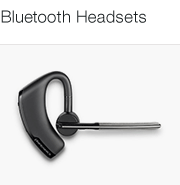
Bluetooth headsets come in all shapes and sizes, designed for
communicating in various situations. One-ear headsets are best for discreetly and comfortably taking calls at work or home.
Two-ear headsets provide a tangle free way to listen to music and talk while you commute, exercise, or kicking back.
Choosing Features
Selecting a Bluetooth headset
with the right features is tricky because features vary by brand.
Fortunately, We have thousands of product reviews and answered
customer questions.
Important things to consider are battery life, noise
cancelation, and weight.
Alongside these features, our editors have
assembled a detailed list of important features.
The Bottom Line
Going hand-free is the way to
go.
Straining your neck, untangling earbuds, and juggling a phone in
your car can be easily avoided with one of our best-selling Bluetooth
headsets, many of which are priced under $50.
Featured Categories
 |
 |
 |
 |
 |
 |
 |
 |
 |
 |


No comments:
Post a Comment